December is a time for holidays, gift giving, and
childhood memories of receiving toys on Christmas or Hanukkah. Ripping into the shiny wrapping paper and
revealing the glistening plastic toy was always a joyful time to remember. I thought I would share this updated toy
analysis I originally posted on my Facebook in 2017. I added a few items and refined my notes. My points are that dolls are not necessarily
sexist, and not just for girls.
* * *
Third Wave Feminists say that girly toys like dolls are
less empowering than Legos, which require building. Dolls are puppets without strings that can be
used for storytelling. That definitely
requires imagination. They aren’t much
different than action figures, whose superhero outfits are built into their
bodies. Action figures suggest
adventure, and dolls are allegedly used for fashion experimentation – unless
you can use your imagination to make them superheroines in ball gowns!
In years past, I walked through the Girls’ section of
Toys R Us when Christmas shopping for my little cousins, and I noticed the
popular lines were Monster High, Ever After High, Barbie, and Disney – in terms
of dolls. There were Goldi-Blocks for
Legos and Nerf guns for girls in 2017.
Then there were techno gadget toys.
I prefer to shop for physical toys for my cousins and not let them get
sucked into the technicolored black hole of a screen too early. I came across some small, colorful toys that
light up – similar to the Blinkins I had as a girl.
Going through my memories of girly toys, when the gender
border was thickly drawn, I still see imaginative uses and the weirdness of
nostalgic surrealism. We didn’t just
play with dolls in the 80s and 90s. Some
of our toys were not even human.
Below is a table listing of all the toys I can remember
from my generation and slightly after. I
did not own all of these. Some of them I
have never seen at a store, like Rose Petal Place dolls. I had a friend who liked that cartoon long
ago. I tried to be objective when making
this list; including the non-feminist toys too.
Some of these toys were loved by boys too, like Care Bears, and Popples. The columns cover topics that feminism
examines like jobs and purposes.
Afterward, I give my analysis involving the qualitative statistics
resulting from the columns.
This table was too large to display, so click to enlarge and then zoom in on the image.
Toy Analysis
There are 53 toys listed.
This is not a comprehensive list of every toy released in
1980-1999. This is only what I could
remember. I could keep adding items to
the spreadsheet, but then I would not be done by Christmas this year. More than fifty toys is a good sample.
Also to note, I retained Barbie and the Easy Bake Oven,
because although they came out earlier, they maintained their presence in the
toy aisles in the time period being observed.
Little Kiddles originated in the 1960s, but they had a gap in production
and were brought back in the 1990s.
The following analyses involve the three columns and a
cross analysis of those columns.
Additionally, I noted the toys’ link to cartoons and movies previously
produced. The terms, Species and
Occupations, are not meant to be taken literally, but only in the sense of
experimental imagination.
Species
Dolls and other toys are objects but they represent living
things that children relate to in imaginary play. The term, humanoid, refers to beings that are
humanlike but not human. For example, a
mermaid is humanoid because she is part human.
The other categories are pretty self-explanatory. A dragon would be a non-human fantasy
creature.
Although there are 53 toys, some series had more than one
type of character, hence the numbers are out of 61. Below is a table with the numbers accounted
per species class. A corresponding chart
comes afterward.
Table 1
Out of 61 characters,
44.2% were human.
16.4% were humanoid.
11.5% were non-human fantasy creatures.
19.7% were animals.
8.2% were playsets or objects that did not represent
living things.
Four toys were floral people or flower dwellers.
Seven toys had a food or baking theme.
Chart 1
Occupation
Toy companies sometimes market toys to have jobs or play
special roles in their fictional societies.
It sets an example for children and to vicariously live out those
responsibilities through the toy. While
going through the list, it seemed like some roles were unintentional and left
open to interpretation. For example,
Rainbow Brite manages a business where sprites mine for star sprinkles, which
provide pigmentation for the world. You
could say she is the CEO of a color corporation, but that’s probably not what
Hallmark intended when marketing their toy.
Some toys had realistic jobs and others did not. Realistic jobs included Baker, Ballerina, and
Perfumer, because those jobs exist in the real world. Of course not all toys are designed to be
associated with jobs. They just have
functions that send simple messages like stay clean, or go to bed. Some toys represent small children or pets
where the focus is caring for them.
However in a fantasy world, animals and children can have societal roles
that are relatable during playtime. Some
characters are children like Strawberry Shortcake, but she appears to have a
job in harvesting strawberries. In the
cartoon, Miss Shortcake is an independent girl who can afford a house without
marrying to attain dual income. She is a
real feminist without bragging about it.
In negating the sexism of girlish toys, it’s important to
take vocational roles into account. Jobs
are empowering for women and in teaching girls their potential.
Chart 2
Table 2 accounts for toys in their varying levels of
employment or exemption.
Only 5 toys were princesses.
1 was a Lady.
22.6%, over one fifth had realistic jobs.
20.7% were either pets, too young to work, or were playsets/non-representative
of living things.
28.3% of the toys were unemployed. They did not seem to have any vocation.
A princess is a political figure, and most girls dream of
enjoying the material wealth of a princess, but the political responsibilities
are absent in play and leadership skills are not taught. On a positive note, jobs that stood out were
Rock star/Orphanage Manager, Superhero, Farmer, Baker, and every job Barbie has
room in her schedule for!
There may have been multiple princess themed Barbie dolls,
but I don’t count her as a princess since the toy line doesn’t emphasize
royalty like Krystal Princesses or She-Ra.
Although princesshood is a highly unlikely career, it has its own
category due to its popularity, and to prove the point that out of 53 toys,
only 11.3% were royalty.
Some careers seemed unrealistic like aviation ballerina,
pollinator, or working in the dream industry.
However they are fantastical roles that allow a child to think and
literally dream outside the box. Regardless
of marketing intentions, children may decide to imagine their toys have jobs
alternative to what’s printed on the box.
The toys are open to their interpretation too. Maybe the Sky Dancer wants to be a doctor.
Purpose
While I indicated some of the toys were tools, like the
Easy Bake Oven and Skip-It, as a general principle I believe all toys are tools
that teach kids something. Each toy has
a purpose, meaning a use.
The following table and chart illustrate the different
purposes of the toys from the sample.
There were 14 toys that had more than one use, so percentages are out of
67 and not 53. Excluded from
multipurpose toys were those listed as “hugging/cuddling,” and it’s counted as
one function.
Table 3
Chart 3
49.25% of the toys were for storytelling.
10.4% had typically sexist purposes – fashion play,
makeup, and motherhood collectively.
26.8% had other uses, most commonly just using features
of the toy.
Just shy of half the toys had a purpose of storytelling,
which served me well because I love to write.
However there wasn’t much diversity in product uses. Playing with multiple product lines can add
more plot to the tales.
Despite that fashion play, cosmetics, and maternity are
associated with female gender roles, young girls back then still wanted to
prepare for motherhood, and model after their moms by playing with makeup and
wearing cool clothes. So toy companies
catered to those wishes. Still, these
uses only accounted for roughly one tenth of the toy functions in the sample,
and that’s with all three categorical uses together.
Under the category of “Other,” was the second highest
purpose in the chart, which was usually just playing with the toy. Among the “other” uses were Making the Blinkins’ butts light up, Flying the Sky Dancer around, and Wish making on the rhinestone crested Troll.
Overall, there needs to be a balance in the toy chest. Dolls are welcome, but also add in building
and exercise toys like blocks, balls, hula hoops, and Play Dough. Then there are board games, which teach
children rules, taking turns, not to cheat, and be a good sport. Toys are tools, and each one teaches
something important.
Based on Media
When an animated series receives high ratings, toy
companies anticipate profitability in an associated toy line. Sometimes it is the reverse, where the toy
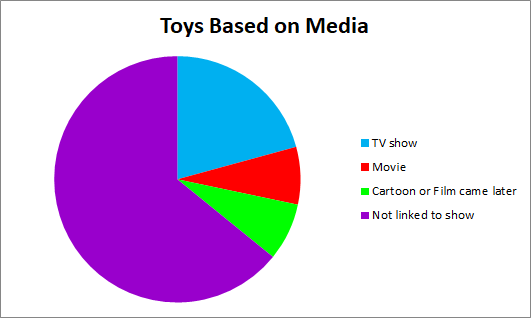
becomes popular enough to support the production of a TV show. The next table and chart account for the
number of toys that are linked to a TV show or movie.
Table 4
Chart 4
The results show that
20.7% were based on a preexisting cartoon series.
64% were not based on a TV show or movie.
Having a preset plot for toys can be positive and
negative. It gives children a starting
point for elaborating on a story, but it’s also the toy corporation providing
their imagination for them, whereas a child should use their imagination on
their own.
The majority of the toys were not linked to any sort of
broadcasted entertainment, so most of the toys were characters and objects
before a blank canvas, letting children create the background.
Cross-Analyze
By focusing on the majorities from each table, we can
gain deeper insight into different aspects of the toys. The following sections involve Species, Occupations,
and Purpose, titled with the mode value.
Human - 27
The most common species represented in the data sample
was human, totaling 27. All of the
princesses were completely human with the exception of Ariel from the Disney
doll collection, who is a half-human fantasy character.
Out of the human represented toys,
One third had realistic jobs.
3 were unemployed.
4 were too young for jobs.
5 had unrealistic jobs.
To give perspective, human looking toys were more likely to be
associated with a profession. One third,
33.333%, of the human toys had practical jobs versus 22.6% for the whole
sample. Three lacked a profession, while
15 out of the whole 53-item sample had no associated professions. That’s one ninth, 11%, of the human toys
versus 28.3% for all toys listed in the sample.
In negation of sexism, most of the dolls were shown to have practical
jobs, which empower a girl’s imagination in believing she can vicariously take
on the role too.
Although toys appearing to be human were more likely to have a
professional role, slightly over half the unrealistic jobs were held by human
toys. Though not everything has to be
serious and realistic; it can just be fun.
All four toys that were “too young to work,” were represented as human
children, though they are just babies, who need care. This allows the girl to entertain a maternal
role. With roles come purposes, which
bring us to the next few stats.
The purposes for those dolls indicate that,
16 out of 27 were for storytelling, 59.25%.
5 were multi-purpose.
12 focused on beauty, 44%.
2 focused on baking.
Almost 60% of the human looking toys were used for storytelling,
whereas 49.25% of the whole data set involved storytelling. It’s a 10% difference. Five humanistic toys were multipurpose, and
the other nine in the whole sample were not human in appearance. Thus it can be inferred that a doll is going
to be single-purposed. More than
two-fifths of the dolls involved beauty culture. The arguments for and against sexism could be
tallied like a scoreboard at this point.
It would make sense that dolls are used for creating stories,
since human beings are the most common characters on television and in
books. It’s easier to identify with the
character if they look somewhat like you.
If cosmetics and perfume were less emphasized, and there was more
variety in the toys’ uses in this area, maybe women and girls could explore
more talents and believe they have more abilities than just applying lipstick. One could see where feminists’ arguments
would be highlighted here.
Also worthy of noting is that,
13 were fantasy-like or originated from a fantasy realm, 48.1%.
6 out of 9 realistically employed were not from a fantasy land.
3 had fantasy characters in their series, 11%.
3 had animals as part of their franchise, 11%.
2 were not dolls, neither had a job.
Almost half the human population of toys had a background in
fantasy, whether it was their homeland or their fantastical selves. Two thirds of the human toys with realistic
jobs didn’t have a fantasy backdrop.
Also 22% of human toys had animal companions or had fantasy friends in
their product line. Surprisingly, two
human toys were not dolls, Smooshies and Star Castles. Humans inhabit the castle, but they aren’t
really dolls. Neither of the non-dolls
appeared to be marketed with an occupation.
Realistic Jobs vs. Unemployed
While it’s obvious that toys don’t have occupations or
unemployment rates, they can be represented as having real jobs as a part of
imaginative play. Moreover, feminism
involves careers. The two most common
stats under Occupations were Realistic Jobs and Unemployed, with the latter being
the mode. The following displays the
statistical points per category.
Realistic
jobs - 12
7 out of 12 were exclusively human.
3 are food related.
3 were beauty focused.
5 were multipurpose.
9 were for storytelling.
Unemployed
- 15
3 were human.
5 were animals.
5 were fantasy-humanoid.
4 were fantasy creatures.
11 out of 15 were for storytelling.
2 were multi-functional.
6 focused on beauty.
1 was food related, plus had its own kitchen and vanity sets.
Over half the toys with realistic jobs were human in appearance,
while only 20% of the toys without a job linked to their product line were
human. It can be inferred that dolls are
more likely to encourage girls to play a functioning role in society or give an
example of what they can do in the future.
This adds some feminism points to the Dolls’ side of the scoreboard.
Almost half the unemployed population consisted of animals and
fantastical creatures, like birds and dragons.
So it’s understandable that a toy company wouldn’t feel the need to give
them specialized positions, because in a fantasy realm the ideation of
vocations is optional.
One quarter of the toys with realistic jobs focused on beauty
culture, whereas 40% of the unemployed toys focused on beauty. So if a doll had a job, it was less likely to
be a beautician. Combining beauty and
food themes, it’s 50% for the practical job group. Comparatively for the unemployed grouping, the
one toy that was food related also had beauty qualities. Their playsets involved sweet treats that
transformed into a kitchen, a vanity, or patio furniture. The dolls themselves transfigured from
cupcakes into human beings. They were
the Cupcake Dolls, a favorite of mine.
Just because a doll isn’t marketed to have a professional job doesn’t
mean they can’t be a collected keepsake with treasured memories.
Maybe the dolls didn’t need jobs since they lived in peaceful
worlds where all their needs were provided to them by the toy company
gods. Maybe some were disabled? In entertaining the creative interpretation
of Flip N Fancy, the conjoined twins could apply for disability. However, they have twice the brain power, and
the two sides could play different roles.
So in playing with the idea, they have twice the ability, rather than
disability. Playskool should have
thought about careers, not just fashion, especially since they had interchangeable
sections. If the company made them 3D,
they could have four sides, have more combinations of outfits to switch around,
and they could be conjoined quadruplets.
This theoretical evolution of Flip N’ Fancy could get a job babysitting
the Quints.
More toys with realistic jobs were multifunctional as opposed to
unemployed toys. A toy designed
intentionally or unintentionally to represent a job was more likely to have a
second use during play. The toys without
a marketed job were more likely to be more simplistic in purpose, like
FairyTails, Bubblins, and My Pretty Mermaid.
The purpose of storytelling was more likely to be found in
unemployed toys than toys connected to a job, but not by a significant
margin. So the storytelling aspect isn’t
really linked to a career. A child could
even pretend a toy has a job without a marketing company labeling it as
such. However, children don’t know all
their career options. With dolls like
Paleontologist Barbie and Veterinarian Barbie, it helps open up a kid’s
blinders that their future isn’t limited to an office cubicle.
Storytelling - 33
While on the topic, storytelling is one of the most basic uses of
toys, arguably since early civilization.
Some dolls were made to simulate motherhood, but with multiple dolls,
stories could be told through their figurative interaction. Storytelling involves role playing, character
development, and evaluating potential causes and effects. A plot could be as simple as having Barbie
and Ken go on a date, or it could be more complex like having My Little Ponies
and Popples team up to go on a treasure hunt through an imaginary mountain
range full of volcanoes where they solicit the help of the lava mermaids and
tropical birds (My Pretty Mermaids and FairyTails) to negotiate a trade with My
Kissing Dragon to share the treasure.
16 were human, 48%.
7 were animals, 21%.
8 were fantasy humanoid, 24%.
6 were fantasy creatures, 18%.
9 had real jobs.
11 were unemployed.
1 was too young for work.
6 had unrealistic jobs.
6 were royalty.
12 were multipurpose.
13 out of 15 toys based on cartoons are made for continuing the
story.
The majority of toys with storytelling qualities were
humanlike, giving children something they can readily identify with because it
resembles them. Both human and fantasy
humanoid account for more than two-thirds of this grouping. A little over two-fifths, 42%,
were fantasy characters whether humanoid or critter. Fantasy is only one genre of tales, so other
plots could unfold with the other 58%.
All of the royalty characters had storytelling aspects to their
usage. Only one of the four toys deemed
“too young for work,” was for storytelling, while the others were for just
using the toy features.
One third of toys made for tale telling were unemployed, so
because creating stories is such a basic function, you might as well use rocks
as dolls to tell a story. However combine
the groups of employed dolls, with real and unrealistic jobs, and they make up
a greater portion, 45%. In effect,
storytelling with set roles does give a child a chance to expand on a
preexisting story. On the negative side,
a corporation is doing the child’s imagining for them, in part. On the positive side, that part is called
inspiration.
Less than half, 36%, were multipurpose, but interesting to note
the most common secondary function was cuddling and hugging. It’s possible that it gives a sense of
security.
Thirteen out of 33 tale spinning toys were preceded by a TV show
or film, which means only two toys from the whole sample were unprecedented by
an entertainment source. Sometimes it’s
fun to continue a story that we see on television. With the story already set, there is a
starting point, but a rigid frame for imaginary play, unless some kids rebel
against marketing ploys and think for themselves. Instead of Blinkins preparing for a harsh
winter and fending off the evil frog and wicked bear from the animated feature,
the Blinkins could run a hotel business and give light shows with their
luminescence.
Last points
All in all, whatever the toy’s purpose is, or whatever
the doll looks like can give varying experiences to each child. The same present could be under the tree or
around the menorah, and no two children would play with that toy the exact same
way.
A toy can inspire you in ways that we hold onto into our
adult years. Cartoons can do the same,
and the toys produced afterward are extensions of those animated
adventures. When I was a young girl, I
liked fun shows like Chip N’ Dale Rescue Rangers and more somber shows like
Rescue 911, and when I played with my Barbies, I tended to role play conflicts
and crime dramas. Now I have a Masters
in Criminal Justice and I have a career in security and investigations.
Look back at your childhood. It doesn’t matter if you’re a girl, a boy, or
a gender non-binary child. Remember
which games and toys you played with, and see if there are any parallels to
your career.
Sources:
Sarah (Sept 2003).
Ghost of the Doll.
[Website]. Retrieved from: https://www.ghostofthedoll.co.uk/toys.php#P
Anonymous (2021). I
Love The 80s. [Website]. Retrieved from: https://ilovethe80s.com/toy/girl/barbie-80s-toys
Other quick resources included Wikipedia and YouTube for
finding release dates and vintage commercial clips.
The rest is from my memories.